This post covers a topic I’ve long wanted to write about, but haven’t had the spark to do so. A recent controversy in the dog training world has prompted me to take action, so here it is! This (long) post will cover the following topics:
- Critique of Behavior Vets: The framing of ADHD-like behaviours in dogs by Behavior Vets fails to recognize ADHD as a stigmatized identity, reducing it to a clinical diagnosis.
- Labeling and Pathologizing: Behaviours are often labeled as problematic without considering the dog’s natural instincts or context, leading to misunderstanding and ineffective interventions.
- Reframing the Discussion: Shifting the focus to executive functions and emotional regulation provides a more compassionate and effective way to support dogs with ADHD-like traits.
- Interest-Based Motivation: Both ADHD individuals and Spaniels are driven by interest and novelty, suggesting that training should be varied and engaging to align with these natural motivations.
- Context Matters: A dog’s behaviour can be misunderstood if their environment doesn’t match their needs, just as humans with ADHD thrive in certain environments and struggle in others.
- Empathy in Training: Applying empathy and understanding in training leads to better outcomes for both dogs and their owners, fostering a deeper connection.
Background and context to this post
The conversation around ADHD-like behaviours in dogs has recently gained traction within the dog training and veterinary communities. A company called Behavior Vets recently promoted a webinar titled “Sparkles & Spice? Helping People and Their ADHD-like Dogs Keep it Together,” which claimed to draw on decades of research into these behaviours. However, the way the topic was framed—focusing on “helping” people manage their “ADHD-like dogs”—quickly drew criticism for its reductive and stigmatizing language. The broader implications of medicalizing and pathologizing these behaviours also raised concerns among many in the field.
One of the voices critiquing this approach is Liza Rader of Focus Dogs, who responded with an open letter. Liza highlighted several issues with how ADHD and neurodivergence were being discussed, particularly the tendency to pathologize behaviours that don’t align neatly with human expectations. Her critique resonated deeply with me. As someone diagnosed with ADHD and who identifies as neurodivergent, I have often encountered similar reductive narratives in discussions about human ADHD. My experiences with my Spaniels have further reinforced my belief that a compassionate, empathetic approach is not only more ethical but also more effective in understanding and managing these behaviours. This article aims to expand on this conversation, offering additional insights into how we can better support dogs with ADHD-like traits.
Please note that I’m not a dog professional, so my anecdotes will focus on the type of dog I have the most experience with. This post is also not intended to be a comprehensive, fully referenced overview of the scientific literature.
Core Critique of Behavior Vets’ Framing of ADHD and Neurodiversity
A central issue with the Behavior Vets’ approach to discussing ADHD-like behaviours in dogs is their failure to acknowledge ADHD as more than just a clinical diagnosis—it is a deeply stigmatized identity. This oversight is significant because it reduces the conversation to a medical framework, stripping away the social and emotional dimensions that profoundly impact those living with ADHD.
ADHD is not merely a collection of symptoms; it is an identity that carries with it a heavy burden of stigma. By not recognizing this, Behavior Vets’ framing of the issue feels incomplete and disconnected from the lived experiences of individuals with ADHD. This lack of recognition perpetuates the very stigma that makes life with ADHD challenging. For many, especially those undiagnosed for years, the most damaging aspect of ADHD is not the symptoms themselves but the stigma and shame that comes from being judged or misunderstood by others.
This is an experience I know all too well. Like many with ADHD, I have spent decades grappling with the social trauma of being labeled as lazy, crazy, or stupid—common misperceptions about ADHD traits. These labels aren’t just words; they are reflections of a society that values conformity and pathologizes those who do not fit neatly into its expectations. The stigma attached to ADHD often leads individuals to internalize these negative judgments, resulting in a deep sense of inadequacy and a disconnection from one’s true self.
One of my biggest critiques of Behavior Vets is their failure to acknowledge that ADHD is not just a medical condition that can be diagnosed and treated; it is also a stigmatized identity that shapes the lives of those who live with it. By overlooking this, they miss a crucial part of the conversation. ADHD is not just about being inattentive or impulsive; it is about navigating a world that often views these traits as flaws. This lack of recognition not only perpetuates stigma but also fails to address the real challenges faced by those with ADHD—challenges that are deeply intertwined with societal perceptions and pressures.
The experience of having natural traits suppressed isn’t unique to dogs; it’s a common experience for many people with ADHD. Society often expects individuals with ADHD to suppress behaviours like hyperactivity, impulsivity, or non-linear thinking to fit into traditional structures like schools or workplaces. This suppression can be deeply harmful, leading to burnout, low self-esteem, and a disconnection from one’s true self. Instead of being supported to develop coping strategies that work with their natural inclinations, individuals with ADHD are often forced to conform to a neurotypical standard that doesn’t accommodate their needs.
This experience mirrors how dogs are often treated when their behaviours don’t fit human expectations. Just as society pressures ADHD individuals to conform by suppressing their natural traits, dogs are similarly pressured to suppress their instincts and behaviours for the sake of human convenience. When a dog’s behaviour doesn’t align with what is considered “normal” or convenient, it is often labeled as problematic or disordered. This suppression of natural behaviours can lead to a loss of identity and well-being, both in humans and in dogs.
For example, a dog that is naturally curious and easily distracted might be labeled as inattentive or hyperactive. But from the dog’s perspective, these behaviours might be perfectly normal expressions of their instincts or breed tendencies. By framing these behaviours as issues to be fixed, rather than natural traits to be understood and managed, we risk perpetuating the same kind of stigma that individuals with ADHD face.
The failure to consider the lived experience of the individual, whether dog or human, reflects a broader issue of ableism and a traditional, hierarchical approach to understanding behaviour. This aligns with Liza Rader’s critique about centering the abled audience’s feelings in discussions about neurodiversity. By focusing on how behaviours inconvenience humans rather than on the well-being of the dog, Behavior Vets reinforces a problematic narrative that prioritizes human convenience over the animal’s natural inclinations and needs. By not addressing the social and emotional dimensions of ADHD, they miss an opportunity to foster a more empathetic and inclusive understanding of these behaviours. The conversation needs to shift from one of pathologizing and suppressing traits that are inconvenient to one that values and supports the natural behaviours and lived experiences of both humans and dogs.
The Problem with Labeling and Pathologizing Behaviours
A significant issue in discussing ADHD-like behaviours in dogs is the tendency to quickly label these behaviours as problematic or disordered without fully considering the dog’s natural instincts or the context. This rush to pathologize can lead to interventions that may be inappropriate or even harmful.
In both humans and dogs, behaviours that don’t align with expectations are often labeled as disorders. However, this labeling often overlooks other potential causes, such as trauma, anxiety, or environmental factors. For example, a dog that appears inattentive or hyperactive might be reacting to stressors or experiencing discomfort. Without thorough assessment, these behaviours can be misunderstood and mislabeled, leading to interventions that don’t address the real issue.
Just as in humans, where a proper ADHD diagnosis involves ruling out other conditions, it’s crucial to consider all possible explanations for a dog’s behaviour before labeling it as ADHD-like. Many behaviours that might be labeled as ADHD-like could actually be signs of trauma, anxiety, or other underlying issues. Mislabeling these behaviours can lead to interventions focused on suppressing symptoms rather than addressing root causes.
Since I’m not a professional, I will quote one:
“In the past 20 years, the focus in humans has shifted to attention deficits, inattentiveness, and related high activity levels (ADHD). This loose constellation of non-specific signs/client complaints has been increasingly used to describe a “hyper-active” dog, in the absence of the criteria or tests that may justify such descriptions in humans. We need to define dogs better on the overactive/hyperactive/hyper-reactive spectrum.” (Overall, 2021 – see end of post for more details)
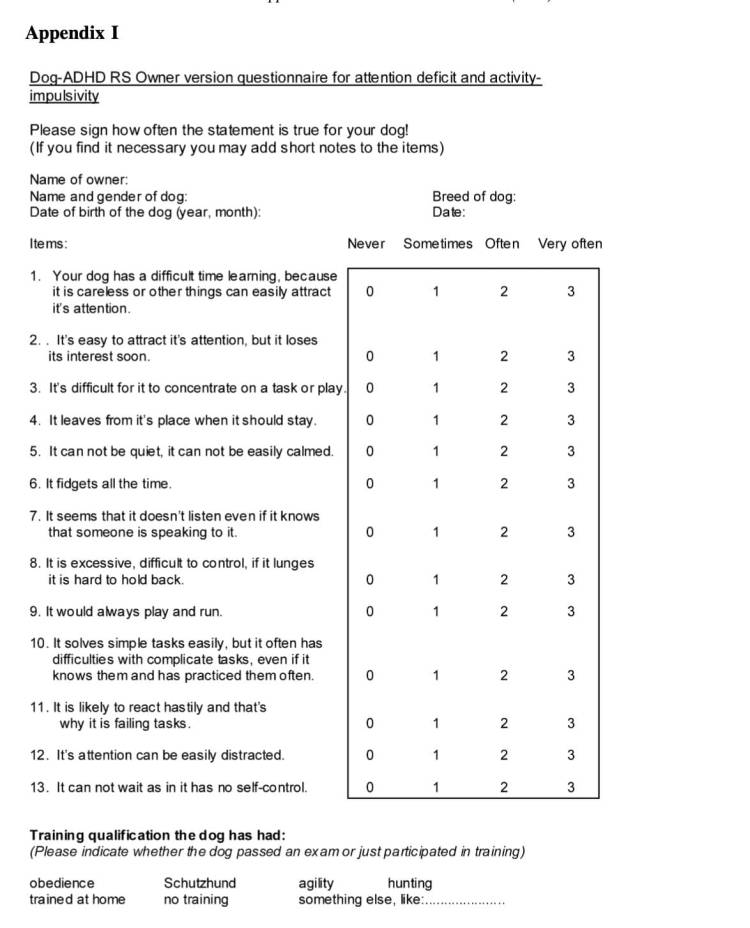
The perspective often taken when labeling behaviours in dogs as ADHD-like focuses primarily on how these behaviours inconvenience the owner. For instance, a dog described as “inattentive” may actually be highly attentive to stimuli in their environment that aren’t significant to their owner. This human-centered view reduces the dog’s behaviour to an inconvenience, ignoring the dog’s lived experience.
This rush to label behaviours without fully understanding their context or cause reflects broader issues in how both human and canine behaviours are often treated. ADHD diagnostic tools in humans, for example, often assess how an individual’s behaviour affects others rather than focusing on the individual’s experience. This approach contributes to stigma by framing ADHD primarily in terms of how it inconveniences others, rather than recognizing it as a part of the individual’s identity that includes both strengths and challenges. Similarly, in dogs, natural behaviours are often labeled as problematic when they don’t align with human expectations.
This failure to consider the individual’s experience, whether human or dog, reflects a broader issue of ableism and a traditional approach to understanding behaviour. Discussions about ADHD-like behaviours in dogs often center on how these behaviours inconvenience humans, reducing complex, natural behaviours to issues that need to be “fixed,” rather than understanding them from the individual’s perspective.
Acknowledging the Complexity of ADHD
While it’s tempting to frame ADHD as a “superpower,” this narrative can be reductive and overlooks the everyday challenges that many individuals with ADHD face. It’s important to recognize that ADHD, like any neurodiverse condition, involves a spectrum of experiences—some challenging, others advantageous—depending on the context.
There are countless examples of highly accomplished individuals with ADHD, including professional athletes like Simone Biles, who have reached the pinnacle of their fields. Biles, a multiple-time Olympic medalist, exemplifies how traits associated with ADHD—such as hyperfocus, quick decision-making, and intense energy—can be harnessed to achieve extraordinary success. Acknowledging these accomplishments highlights that ADHD is not just about challenges; it also includes strengths that can lead to remarkable achievements.
However, focusing solely on these successes can create a distorted view that overshadows the very real difficulties that come with ADHD. For many, ADHD is a double-edged sword—capable of producing great achievements in the right environment, but also leading to significant struggles in settings that don’t align with their strengths.
This complexity mirrors how we should understand ADHD-like traits in dogs. Just as neurotypical individuals have their own strengths and weaknesses, so do those with ADHD or other neurotypes—the difference lies in what society deems valuable. The same arbitrary value judgments are now being passed onto dogs. Behaviours that align with human convenience or expectations are often praised, while those that don’t are labeled as problematic. This approach fails to appreciate the full spectrum of canine behaviour, especially in breeds that have been selectively bred for specific traits that may not always align with modern domestic life.
Behaviours should be evaluated within the context of the dog’s breed and original role. What might seem problematic in one setting could be a natural and beneficial trait in another. By starting from the point that ADHD involves both strengths and challenges, we can move away from reductionist narratives that view these traits exclusively through a lens of inconvenience or pathology and instead consider how certain traits might be advantageous or reflect a dog’s natural tendencies.
Understanding this balance allows us to take a more nuanced and compassionate approach to both human and canine behaviour. It’s not about denying the challenges or overselling the strengths; it’s about recognizing that both are inherent parts of the experience. In doing so, we can better support and appreciate the unique contributions of individuals with ADHD, whether they are humans or dogs.
Understanding Contextual Strengths and the Consequences of Mismatching Environments
The key to understanding both human ADHD and “ADHD-like traits” in dogs lies in recognizing that strengths and weaknesses are context-dependent. A spaniel’s high energy and drive are assets in a hunting context but can become challenges in a domestic setting where those needs aren’t met.
When a dog’s natural abilities are mismatched with their environment, it can lead to frustration for both the dog and the owner. This mismatch can result in the dog’s behaviour being labeled as problematic, when in reality, it’s simply a reflection of the dog’s unsatisfied needs or instincts. Understanding this is crucial for ensuring that dogs are placed in environments where their natural traits are valued and appropriately channeled.
Spaniels have been bred specifically for hunting tasks such as flushing and retrieving game. Their high energy, persistence, and strong drive are all traits that make them exceptional at these tasks. However, these abilities can be seen as problematic when a spaniel is kept in a domestic setting without appropriate outlets for their energy and instincts. In this context, behaviours like restlessness, hyperactivity, and impulsivity might be incorrectly labeled as behavioural issues, when they are simply the dog’s natural traits manifesting without a proper outlet.
Conversely, the very traits that make spaniels excellent hunting dogs would make them ill-suited for roles like herding or guarding. A spaniel’s high energy and distractibility would likely make them ineffective as a sheepdog, where focus and control over impulses are crucial. Similarly, their friendly and social nature might undermine their effectiveness as guard dogs, where suspicion and territoriality are valuable traits. Instead of recognizing that a spaniel’s hyperactivity or impulsivity is linked to their natural instincts and breeding, these traits are often pathologized. This not only misunderstands the dog’s behaviour but also disregards the fact that these traits are advantageous in contexts like hunting. By not considering the dog’s instincts, we risk suppressing behaviours that are essential to the dog’s well-being and natural disposition.
The same logic applies to humans with ADHD. Many individuals with ADHD thrive in dynamic, fast-paced environments where their ability to think quickly, adapt to changing circumstances, and hyperfocus under pressure becomes an asset. For example, roles like firefighting, emergency response, or creative industries often require quick decision-making and the ability to manage multiple stimuli, making these environments well-suited for individuals with ADHD. Conversely, the same traits that make ADHDers excel in dynamic roles can become a challenge in more routine-oriented jobs, such as accounting or administrative work. The need for sustained attention, repetitive tasks, and a structured environment can be difficult for someone with ADHD, leading to struggles with focus, productivity, and adherence to deadlines.
Just as different dog breeds excel in different roles, humans also have diverse abilities that should be recognized and appreciated in the right context. The key is to match individuals—whether human or canine—with environments where their natural traits are assets, rather than trying to force them to conform to environments where they struggle. By recognizing that strengths and weaknesses are context-dependent, we can foster a more flexible and inclusive approach to both dog training and human employment. This approach values the unique contributions of each individual, whether human or dog, and ensures that they are placed in environments where they can thrive.
Reframing the Conversation Around Executive Functions and Emotional Regulation
Rather than narrowly focusing on ADHD-like behaviours in dogs, a more productive approach is to frame the discussion around executive functions. Executive functions are cognitive processes, including working memory, flexible thinking, and self-control, that everyone—human or dog—relies on to manage behaviour. Impairments in executive functioning can arise for various reasons and are not unique to ADHD.
Discussing behaviours in terms of executive function broadens the conversation and makes it more inclusive. This perspective helps destigmatize behaviours and focuses on practical ways to support and improve executive functioning, rather than simply labeling behaviours as disordered. For dogs, this means recognizing that behaviours often labeled as ADHD-like might actually be signs of challenges in executive functioning, such as difficulties with impulse control or attention regulation.
A critical component of executive functioning is emotional regulation, which is particularly relevant when discussing ADHD. Emotional regulation refers to the ability to manage and respond to emotional experiences in a healthy way. For those with ADHD, emotional dysregulation can be a significant challenge. It’s not just about managing attention; it’s also about managing the emotions that accompany different stimuli, including the discomfort or even pain of boredom or overstimulation.
Just as humans with ADHD may struggle with emotional regulation, dogs too can experience similar challenges. For instance, a dog that appears hyperactive or impulsive might actually be responding to emotional dysregulation—perhaps feeling overwhelmed or under-stimulated. Recognizing this connection allows for a more empathetic approach to their behaviour, understanding that these behaviours are often responses to their emotional state and challenges in executive functioning, rather than deliberate defiance or misbehaviour.
Reframing the conversation around executive functions shifts the focus from stigmatizing behaviours as inherently problematic to a more compassionate understanding. This approach allows us to offer better support, whether that means adjusting training methods for dogs, providing more appropriate outlets for their energy, or offering accommodations for humans to help manage their executive functioning challenges.
Interest-Based Motivation in ADHD and Spaniels
One of the key insights from my experience with ADHD is understanding that attention and motivation aren’t driven by traditional notions of importance or status but by what captures immediate interest, novelty, urgency, or inherent curiosity. This concept, known as interest-based motivation, is central to how I approach both my own behaviours and those of my spaniels.
Spaniels, in many ways, embody what could be described as an ADHD-like cluster of traits. Their behaviour isn’t just about inattentiveness or impulsivity—traits often highlighted when discussing ADHD—but about the underlying motivation system that drives these behaviours. For spaniels, their attraction to novelty is a direct byproduct of their original job as hunting dogs. They are naturally inclined to explore and react to new stimuli in their environment, a trait essential for their role in flushing out game. This attraction to novelty can sometimes manifest as impulsivity, but understanding its root can transform how we approach training and interactions.
Just as people with ADHD may struggle with tasks that lack novelty or excitement, spaniels can quickly lose interest in repetitive drills or exercises that don’t engage their curiosity. For these dogs, the key to effective training isn’t in rigid repetition but in maintaining variety, keeping tasks novel and engaging. Recognizing that their motivation is driven by what’s new or interesting, rather than simply following commands for the sake of it, allows us to tailor training to better suit their needs. This might mean incorporating diverse activities, using varied rewards, or frequently changing up routines to keep their interest piqued.
A guiding principle that resonates with both ADHD individuals and spaniels is the idea that if it’s not fun, it’s not going to hold attention. This isn’t just about avoiding boredom; it’s about understanding how motivation works. For spaniels, as for people with ADHD, training that is engaging, fun, and varied will always be more effective than training that relies on monotony or rigid structure. Recognizing this can lead to more successful, enjoyable training sessions and a better understanding of the dog’s needs and natural inclinations.
Unfortunately, this interest-based motivation system is often misunderstood, leading to frustration or even harsh judgments about the dog’s behaviour. Just as people with ADHD are sometimes unfairly labeled as lazy or unmotivated, dogs driven by curiosity and novelty might be seen as difficult or disobedient. In reality, their behaviour is a reflection of their natural wiring—something that, when understood and respected, can lead to much more positive and effective training outcomes.
The Role of Empathy, Acceptance, and Self-Understanding
Empathy, both towards ourselves and our dogs, plays a crucial role in how we approach and manage behaviours that are often labeled as problematic.
My first spaniel, Nell, was instrumental in helping me develop a deeper sense of empathy—not just for her, but for myself as well. Her behaviours often mirrored traits in myself that I had been taught to suppress or be ashamed of. The frustration I initially felt toward her intensity was the same frustration I had long directed at myself. Living with Nell forced me to confront these traits in both of us, leading to greater self-understanding and acceptance.
One of the most valuable lessons from this experience was learning to prioritize the dog’s perspective. My personal experience with ADHD has taught me to always ask, “What is the dog experiencing?” before reacting to a behaviour. Understanding their perspective helps me figure out how to assist them in coping better with the situation. For instance, if they need to wait, providing them with something to sniff or a simple task can make all the difference. Approaching the situation with empathy, rather than thinking, “I shouldn’t need to do that,” helps avoid the kind of judgment that often leads to negative outcomes for both dogs and people with ADHD.
Understanding that a fast-processing brain can be both a challenge and an advantage has also shaped my approach to training. Dogs, especially working breeds, often process information quickly, and this rapid learning ability can lead to impatience if they are under-stimulated. Instead of labeling them as impatient or difficult, I now see these behaviours as a signal that they may need more mental or physical engagement. This approach shifts the focus from frustration to empathy, allowing me to provide the right level of stimulation to keep them engaged and satisfied.
Similarly, recognizing that dogs, like people with ADHD, can get temporarily distracted, I’ve found it helpful to gently remind them of what they were doing by repeating a cue. Instead of becoming frustrated, I now approach these moments with empathy, understanding that just as I sometimes need a nudge to get back on track, so do they. This small adjustment in approach—acknowledging that a brief distraction is not inherently wrong—allows for a more compassionate interaction.
By fostering empathy and understanding in our relationships with our dogs, we not only improve their well-being but also deepen our connection with them. This mutual understanding and acceptance create a more positive and supportive environment for both the dog and the owner, leading to more effective and compassionate training outcomes.
Conclusion
As we explore the intersection of ADHD-like behaviours in dogs and human ADHD, it becomes clear that the traditional approaches—rooted in pathologizing and convenience—fail to capture the full complexity of these experiences. Whether we are talking about dogs or humans, it’s crucial to move beyond a focus on how behaviours inconvenience us and instead prioritize empathy, understanding, and support.
Dogs, like humans, have unique traits shaped by their history, breeding, and environment. When these traits don’t fit neatly into modern expectations, they are often mislabeled as problems to be fixed. But by recognizing the context and natural inclinations of both dogs and people with ADHD, we can begin to appreciate their strengths, address their challenges with empathy, and create environments where they can thrive.
The conversation needs to shift from one of labeling and suppression to one of acceptance and support. This means understanding that behaviours often labeled as ADHD-like are not inherently problematic but are instead expressions of natural instincts or challenges with executive functioning and emotional regulation. By reframing the discussion, we can move towards more compassionate, effective, and ethical approaches in both dog training and human support.
Ultimately, the goal is not to force conformity but to foster environments where the unique traits of both humans and dogs are valued and nurtured. Through empathy, acceptance, and a deeper understanding of these behaviours, we can build stronger, more fulfilling relationships with our dogs and ourselves, while also challenging societal norms that prioritize convenience over compassion.
| Overactivity | Hyperactivity/hyperkinesis | Hyper-reactivity |
| Motor activity that is in excess of that exhibited when the animal experiences a regular exercise and interaction schedule and that occurs in the absence of any signs of organic disease or true hyperactivity. Overactivity resolves with increased aerobic activity and interaction. Overactivity must be distinguished from attentionseeking behavior, hyperactivity, and hyper-reactivity. Overactivity is a diagnosis that is not divorced from either the environment (the context in which the determination must be made) or from the client’s understanding of “normal” behavior for the dog’s breed and age. | Motor activity in excess to that warranted by the animal’s age and stimulation level that occurs in a consistent manner and that does not respond to “correction,” re-direction, or restraint. For true hyperkinesis to be diagnosed, there is the additional requirement of sympathetic signs (increased heart rate, increased respiratory rate, vasodilation) even when at rest. Most dogs that clients call hyperactive—a diagnosis that does not depend on the dog’s exercise level compared with his or her needs—are actually overactive— a diagnosis that does depend on the dog’s exercise level compared with his or her needs. Hyperactivity is a very specific diagnosis for which specific behavioral signs have been poorly elucidated. Unfortunately, this term is used a lot but seldom truly defined. | Physical and behavioral response to an external stimulus (e.g., a sound or smell), activity, or social stimulus that is out of context, given the stimulus, and/or extreme in form, frequency, intensity, or duration. Affected dogs usually have a low threshold for reactivity and extremely rapid arousal. Before making this diagnosis, it is important to ensure that the dog is not overactive (inadequately exercised or stimulated) and that he or she does not have GAD, in which the dog is anxious across classes of stimuli and motor activity is a failed response for dealing with the anxiety. Dogs who are truly hyper-reactive may not be distressed. |
 BusyDoggie